Female pattern hair loss in noida is the most common cause of hair loss in women, yet it remains dramatically under-discussed. If you are noticing your ponytail getting thinner or your parting widening, you are not alone — and there is real help available.
Table of Contents
- How It Differs from Male Pattern Loss
- Ludwig Scale: Staging Female Hair Loss
- Root Causes in Women
- Getting a Diagnosis
- Evidence-Based Treatment Options
- Emotional Impact and Support
How Female Hair Loss Differs from Male Pattern Baldness?
While both share the same underlying mechanism (DHT-driven follicular miniaturization), female pattern hair loss has a distinct presentation. Women rarely develop the classic “M-shaped” receding hairline seen in men. Instead, they experience diffuse thinning primarily across the crown and top of the scalp, with the frontal hairline usually preserved.
This diffuse pattern makes it harder to notice early on. Many women simply use a thicker ponytail band or change their parting and don’t realise the extent of thinning until a doctor points it out.
Prevalence Data
According to research published in the British Journal of Dermatology, female pattern hair loss affects approximately 12% of women by age 29, rising to over 40% by age 69.
The Ludwig Scale: Classifying Female Hair Loss
The Ludwig scale categorizes female pattern hair loss into three stages:
- Ludwig I: Mild thinning at the parting. The scalp is more visible through the hair, but the overall hair density still looks reasonable.
- Ludwig II: Moderate, noticeable widening of the parting and decreased volume across the crown. Many women first seek professional help at this stage.
- Ludwig III: Severe thinning at the crown, with the scalp clearly visible through diffuse, fine hair. The frontal hairline is typically still intact.
The Sinclair scale (an alternative classification) adds two more subtypes and may be preferred by some dermatologists for its granularity.
Root Causes of Hair Loss in Women
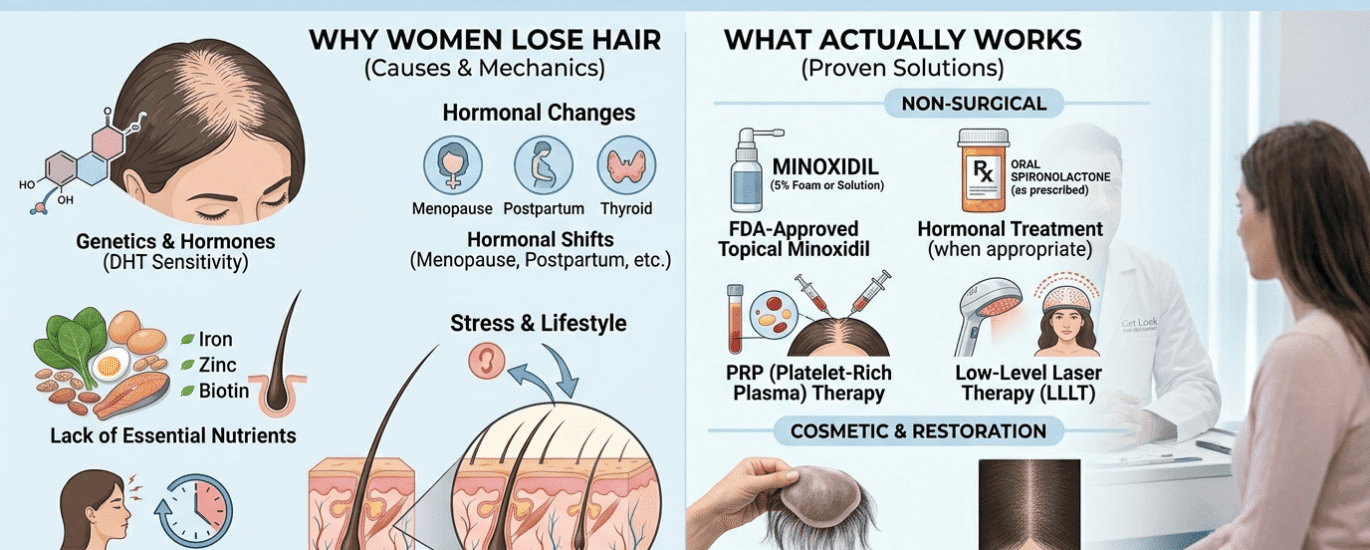
While genetics and androgens drive most cases, several additional factors are more relevant in women than men:
- PCOS: Polycystic ovary syndrome raises androgen levels, directly accelerating hair miniaturization in susceptible women.
- Thyroid dysfunction: Both an underactive (hypothyroid) and overactive (hyperthyroid) thyroid can cause significant shedding and thinning.
- Iron deficiency: Low ferritin is one of the most common correctable causes of female hair loss. Levels below 30–40 ng/mL are associated with increased shedding.
- Perimenopause and menopause: As estrogen declines, DHT’s effect on follicles becomes more pronounced, triggering or accelerating female pattern loss.
- Oral contraceptives: Switching or stopping certain contraceptive pills can trigger telogen effluvium or exacerbate genetic thinning.
How to Get a Proper Diagnosis?
Because so many conditions cause hair loss in women, a thorough workup is essential before starting treatment. A dermatologist will take a detailed history, examine the scalp with dermoscopy, and run blood tests including ferritin, full blood count, thyroid hormones (TSH, T3, T4), vitamin D, zinc, testosterone, and DHEAS.
This panel helps distinguish androgenetic alopecia from reversible causes like iron deficiency or thyroid disease — an important distinction because the treatment approaches differ significantly.
Evidence-Based Treatments for Women
Minoxidil (2% topical solution) is the only FDA-approved topical treatment for female pattern hair loss. The 5% foam is also used off-label and may be more effective. Oral low-dose minoxidil (0.25–1mg daily) has shown excellent results in several recent clinical studies with fewer scalp-related side effects.
Spironolactone, an anti-androgen, is widely used off-label in women and has good clinical evidence. Finasteride and dutasteride are also used in post-menopausal women after discussion of risks and benefits. Platelet-rich plasma (PRP) injections and low-level laser therapy offer supplementary options, particularly for those who cannot tolerate oral medications.
“ Treating any underlying deficiency first is crucial. Correcting iron deficiency alone can produce meaningful improvement in hair density within 6–12 months, without additional medication. ”
The Emotional Impact and Where to Find Support
Hair loss profoundly affects self-image and confidence, particularly for women, in a society that strongly associates femininity with hair. Studies consistently show that women with pattern hair loss score higher on depression and anxiety scales than those without. These feelings are entirely valid — and should be taken seriously.
The National Alopecia Areata Foundation (NAAF) and organizations like Alopecia UK offer peer support groups. Connecting with others navigating similar experiences can be just as therapeutic as any medical treatment. Seeking support from a counsellor or psychologist alongside medical treatment is strongly recommended.
FAQ's - Female Pattern Hair Loss
It is not permanent when addressed with treatment; while it can be progressive without intervention, hair can be maintained or restored through proven solutions.
Recommended tests include levels for iron and ferritin, zinc, vitamin D3, vitamin B12, biotin, and a thyroid panel, though you should consult a specialist to determine your specific needs.
Yes, it is an FDA-approved and proven treatment that helps stimulate new growth and increase hair density by reversing follicle miniaturization.
Yes, optimal nutrition is crucial for healthy hair production, with essential nutrients including iron, zinc, biotin, and protein.
Yes, hormonal shifts during and after menopause frequently cause thinning, but this is not permanent and can be managed with proactive care.
GET IN TOUCH
Any Queries? Contact Us Now.
Medical Disclaimer: This article is for informational purposes only and does not constitute medical advice. Always consult a qualified dermatologist or trichologist for diagnosis and treatment.