You can’t see stress, but your hair often tells the story weeks later. Telogen effluvium —hair loss and stress-triggered hair shedding — is one of the most common yet misunderstood forms of hair loss, and the good news is that it is almost always reversible.
Table of Contents
- What Is Telogen Effluvium?
- Common Triggers
- The Timeline of Shedding
- Diagnosing TE vs Other Conditions
- How to Speed Up Recovery
- When TE Becomes Chronic
- What Is Telogen Effluvium?
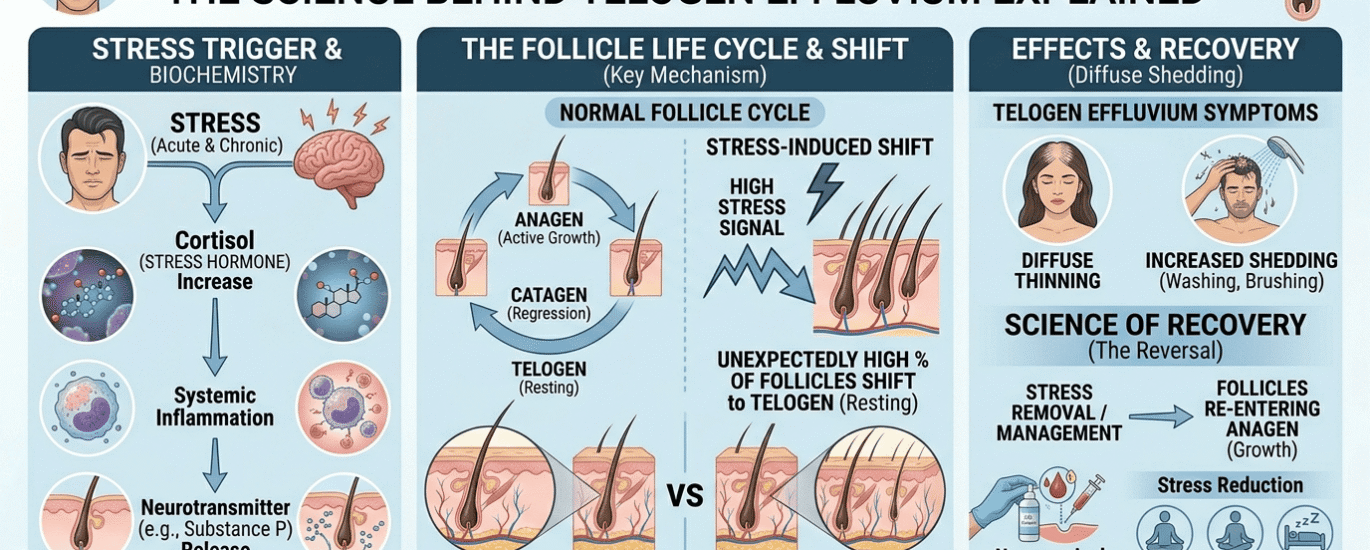
Telogen effluvium (TE) is a diffuse, non-scarring hair loss condition caused by a disruption to the normal hair cycle. Under stress — physical or psychological — a larger-than-normal proportion of hair follicles abruptly shift from the active growth phase (anagen) into the resting phase (telogen).
Around 2–3 months later, all those telogen hairs shed simultaneously. Instead of the normal 50–100 hairs lost per day, someone experiencing TE may shed 200–400 hairs daily. Running your fingers through wet hair and finding a handful each time is a classic sign.
” Key Stats
Dermatologists report that telogen effluvium is the second most common cause of hair loss they see in clinical practice, behind only androgenetic alopecia. “
Common Triggers of Telogen Effluvium
Almost any significant physiological or emotional shock to the body can trigger TE. The most common include:
- Major surgery or general anaesthesia
- Severe acute illness, high fever, or COVID-19 (post-COVID TE was widely reported in 2020–2022)
- Significant emotional trauma or prolonged psychological stress
- Childbirth (postpartum TE is one of the most common forms)
- Crash dieting, very low-calorie intake, or rapid weight loss
- Starting or stopping certain medications (notably oral contraceptives)
- Iron deficiency or sudden nutritional deprivation
- Hypothyroidism or hyperthyroidism
The Timeline of Stress-Related Hair Shedding
Understanding the TE timeline can be reassuring. The stressor typically occurs, and hair shedding begins 6–12 weeks later — not immediately. This delay often confuses people, who may not connect their current shedding to an illness or stressful event from 2–3 months prior.
The shedding phase itself usually peaks at around 3–4 months after the trigger event and then gradually decreases. Most cases of acute TE resolve completely within 6–9 months, with full hair density restoring by 12–18 months.
Diagnosing Telogen Effluvium vs Other Forms of Hair Loss
A dermatologist can often diagnose TE through the pull test: gently pulling 40–60 hairs from multiple scalp areas. Pulling out more than 10% suggests active TE. Trichoscopy reveals normal follicle density with increased empty follicle openings — a key differentiator from androgenetic alopecia, which shows miniaturized follicles.
Blood tests are essential to rule out underlying drivers (especially thyroid disease and iron deficiency), which may coexist with stress as triggers. Keeping a hair loss diary — noting daily shed counts — is surprisingly useful for tracking the natural recovery arc.
” One of the most distressing aspects of TE is finding shed hairs with a small white bulb at the root. This is simply the telogen hair bulb — normal root morphology — not a sign of permanent damage. Follicles remain intact and will regrow. “
How to Speed Up Recovery from Telogen Effluvium?
The most important step is addressing the underlying trigger. If the stressor was a one-time event (surgery, illness), the body often corrects itself without intervention. For ongoing triggers, you need to actively manage them:
- Correct nutritional deficiencies — especially iron and vitamin D — with supplementation under medical guidance.
- Optimise protein intake: aim for at least 1.2–1.6g of protein per kilogram of body weight daily.
- Reduce chronic stress through regular exercise, adequate sleep (7–9 hours), and mindfulness-based stress reduction.
- Topical minoxidil can be used to support regrowth during recovery, though it is not always necessary.
- Scalp massage (5 minutes daily) has some evidence for stimulating follicle activity and improving blood flow.
When Telogen Effluvium Becomes Chronic?
In a small proportion of cases, TE persists for more than 6 months — termed chronic TE. This is more common in women aged 30–60 and often has multiple overlapping triggers. Chronic TE needs careful investigation to identify and address all contributing factors.
Importantly, chronic TE does not typically result in complete baldness; it rarely causes hair density to drop below 50% of baseline. However, the psychological toll of prolonged shedding is real, and appropriate support — both medical and emotional — is essential.
FAQ's - Frequently Asked Questions
Stress-related hair loss, known as telogen effluvium, is typically characterized by diffuse thinning and increased shedding, particularly noticeable during washing or brushing.
Yes, once the stressor is removed or managed, the science of recovery indicates that the hair follicles can re-enter the anagen (growth) phase.
The guide explains that stress causes an unexpectedly high percentage of follicles to shift into the resting phase, which results in diffuse shedding rather than a specific numerical amount of loss.
Chronic stress can lead to systemic inflammation and the release of neurotransmitters that negatively impact the hair follicle life cycle.
While specific supplements are not mentioned, the guide highlights stress reduction techniques such as meditation, yoga, and sleep, alongside non-surgical solutions, as effective ways to support recovery.
Medical Disclaimer: This article is for informational purposes only and does not constitute medical advice. Always consult a qualified dermatologist or trichologist for diagnosis and treatment.