What is Female Pattern Hair Loss (FPHL)?
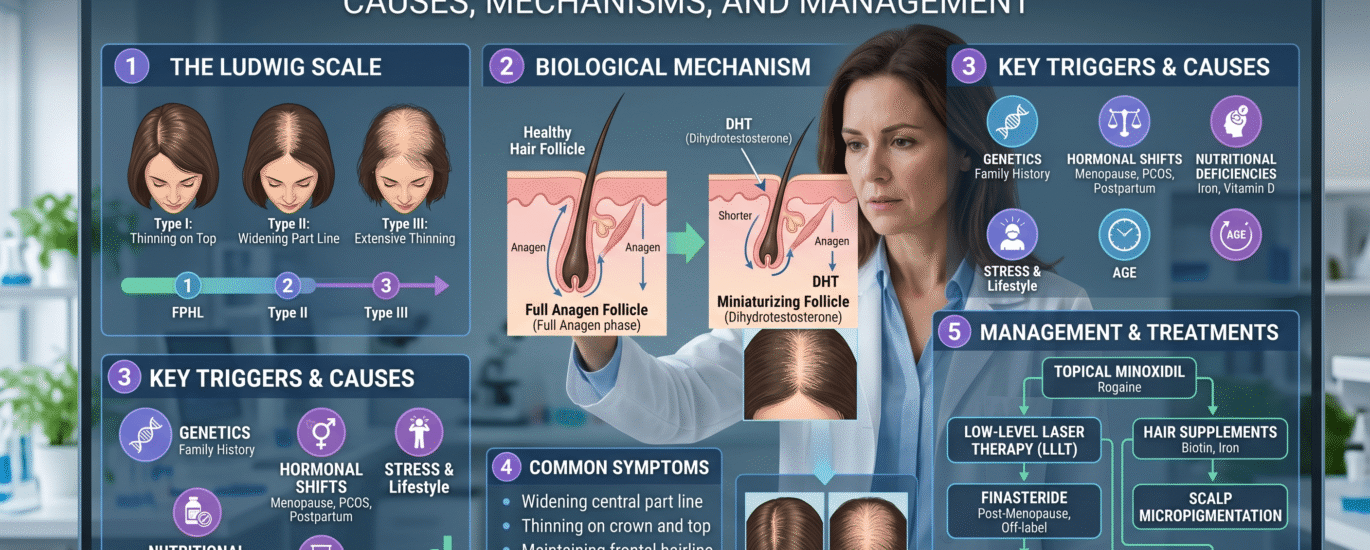
Female Pattern Hair Loss (FPHL) is a genetically determined condition characterized by the progressive miniaturization of hair follicles, leading to a visible decrease in hair density along the mid-scalp and crown. Driven by a combination of genetics and the influence of androgens (specifically DHT), FPHL differs from male baldness in that the frontal hairline is usually preserved, while the "part" line gradually widens and the overall volume of the hair shaft diminishes.
The Ludwig Scale of Hair Thinning
Clinicians utilize the Ludwig Scale to categorize the severity of FPHL, focusing on the degree of rarefaction across the top of the scalp.
Grade I: Perceivable thinning on the crown, where the hair may still be styled to cover the scalp.
Grade II: Significant widening of the midline part and a noticeable decrease in hair volume. A "Christmas Tree" pattern may become visible, where the thinning is most acute at the top and tapers toward the forehead.
Grade III: Extensive thinning across the entire top of the scalp; the scalp is clearly visible through the remaining fine, miniaturized hairs. Total baldness is extremely rare in FPHL, unlike in male pattern loss.
The Role of DHT and Genetics
The biological driver of FPHL is the sensitivity of hair follicles to dihydrotestosterone (DHT), a derivative of testosterone. When DHT binds to receptors in the hair follicle, it triggers a shortened anagen (growth) phase and a prolonged telogen (resting) phase. Over successive cycles, the follicle shrinks, producing thinner and shorter "vellus-like" hairs until the follicle eventually ceases production. While hormonal shifts—such as those during menopause—can exacerbate the condition, the underlying cause is typically an inherited predisposition to follicular sensitivity.
Clinical Signs: FPHL vs. Telogen Effluvium
Clinical Signs: FPHL vs. Telogen Effluvium
It is essential to distinguish FPHL from Telogen Effluvium (TE) to ensure correct clinical intervention. FPHL is a slow, progressive miniaturization of follicles, whereas TE is a sudden, diffuse shedding of terminal hairs often triggered by acute stress, nutritional deficiencies, or illness. In FPHL, the clinician will observe varying hair shaft diameters (anisotrichosis) under a trichoscope, whereas in TE, the hair shafts remain a uniform thickness but are shed prematurely in their entirety.