Forget what you knew about old toupees... welcome to the future of hair design | Non-Surgical Hair Replacement
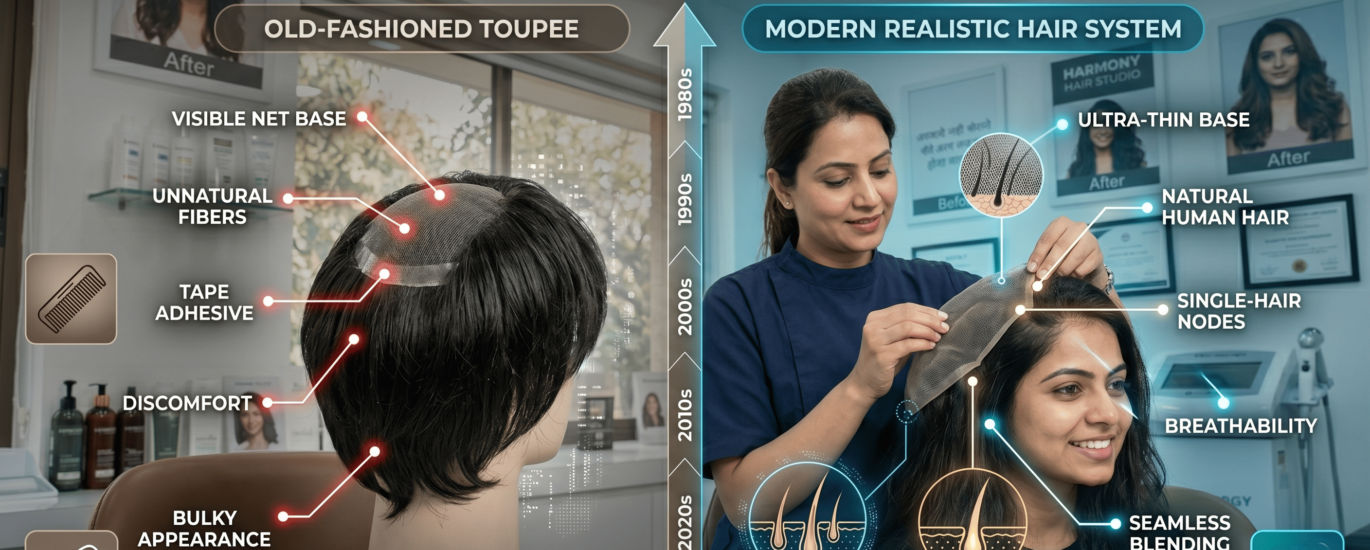
The history of hair restoration is a tale of rapid technological advancement. If you look back even twenty years, the term “hair replacement” was often associated with unnatural, static-looking toupees that were prone to shifting and were easily spotted in bright light. Today, the industry of non-surgical hair replacement has undergone a complete metamorphosis, driven by high-tech material science and a shift toward extreme realism.
From Static to Dynamic | Non-Surgical Hair Replacement
The early days of hair systems were hampered by limitations in materials. Bases were often made of thick, artificial fabrics that were stiff, itchy, and lacked ventilation. Hair was typically synthetic, resulting in a “plastic” shine that didn’t match the organic, multi-tonal appearance of real human hair.
In contrast, modern non-surgical hair replacement is defined by the quest for “invisibility.” We have moved into the era of the “ultra-fine base.” Modern systems utilize lace so delicate it can barely be seen under a magnifying glass, and polyurethane skins that are thinner than a human hair. These materials are designed to be permeable, allowing the skin to breathe and natural oils to move away from the scalp, which in turn extends the life of the unit and the bond.
The Role of Customization | Non-Surgical Hair Replacement
The most important shift has been the focus on hyper-personalization. We now have the ability to replicate a client’s scalp color, their exact hair density, and the specific way their hair grows (the “growth pattern”). By mimicking these details, we create a restoration that doesn’t just “sit” on the head but appears to be growing from it.
Furthermore, the bonding technology has advanced alongside the materials. We have moved away from permanent-glue methods that were damaging, toward sophisticated, dermatologically tested adhesives that provide a secure, temporary hold. This shift toward a “modular” hair restoration experience—where you can remove, clean, and reset your system—has made the process more hygienic, comfortable, and aesthetically superior than ever before.
FAQ's: The Evolution of Non-Surgical Hair Replacement
Modern systems use 100% real human hair, ultra-fine base materials that mimic the skin, and precision knotting techniques that match natural growth patterns.
Yes, low-quality, mass-produced systems still exist. The difference between a high-end, realistic unit and an obvious one remains the quality of materials and the skill of the professional applicator.
GET IN TOUCH
Any Queries? Contact Us Now.
Medical Disclaimer: This article is for informational purposes only and does not constitute medical advice. Always consult a qualified dermatologist or trichologist for diagnosis and treatment.